






The security operations center is undergoing its biggest structural shift in two decades. The recent launch of the Agentic SOC Alliance signals a major milestone: enterprise defense is officially standardizing around an autonomous operating model built on three core layers: Context, Harness, and Model.
It is a well-crafted architecture designed for an undeniable reality. Yet, in defining this next-generation framework, the industry has an opportunity to expand the definition.
Within the Alliance’s blueprint, the durable Context layer explicitly feeds autonomous agents with structured telemetry across three core pillars: Network, Endpoint, and Identity. This foundation is essential. However, as enterprise work migrates from local desktop environments to web-first interfaces, the definition of what constitutes complete Endpoint and Identity evidence must naturally evolve to include the browser runtime.
Why SOCs Exist (and Why They Are Going Agentic)
At its core, a SOC exists to protect an organization’s crown jewels such as sensitive customer records, intellectual property, financial transactions, and proprietary business logic. For twenty years, defenders guarded those assets using a human-speed workflow: queue, enrich, triage, investigate, escalate.
That pipeline worked well when attacks unfolded over days or weeks. It breaks down completely in the era of AI-driven, machine-speed adversaries who can discover a vulnerability, weaponize an exploit, and execute lateral movement within hours.
As the Agentic SOC Alliance rightly points out, human-paced triage cannot be optimized fast enough to close this gap. Security operations must be rebuilt around autonomous AI agents that can ingest context, evaluate evidence, and orchestrate responses at machine speed.
However, machine-speed reasoning is only as effective as the sightline behind it. If an agent is blind to where data is actually first created, as well as where it lives and moves, even the fastest model will draw flawed conclusions.
Where High-Value Data Is Exposed Today
To understand why the browser session is central to modern risk, look at where high-value data is actually rendered, entered, and processed. The browser is no longer just a passive viewer for static web pages; it is the active execution environment for both customer-facing applications and internal workforce operations.
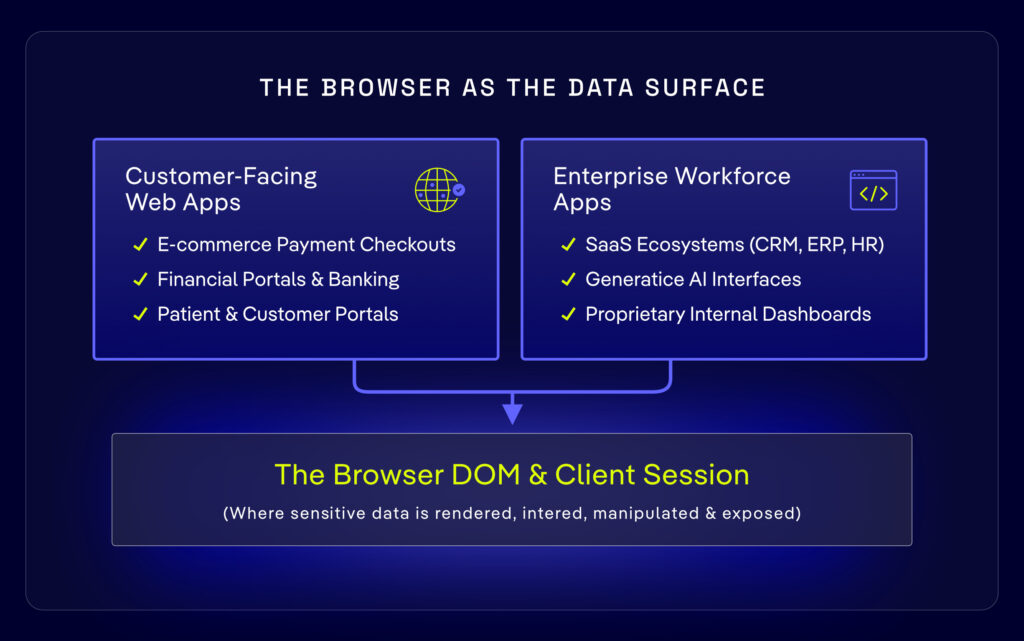
Whether an organization is running a public-facing e-commerce store, a banking portal, or internal operations, the crown jewels pass directly through the browser Document Object Model (DOM) before reaching backend servers or disk storage:
- Payment & Cardholder Data (PCI): Credit card numbers, CVVs, and billing addresses typed directly into customer-facing checkout pages and payment gateways.
- Personally Identifiable Information (PII) & Health Records (PHI): Customer identities, SSNs, financial records, and medical histories handled across banking platforms, customer portals, and SaaS environments.
- Intellectual Property & Proprietary Code: Source code, strategic roadmaps, and trade secrets rendered inside internal web applications or pasted into web-based AI tools.
- Competitive & Commercial Data: Pricing strategies, sales pipelines, and financial performance data viewed and edited in web-based business applications.
Because this data is decrypted and rendered client-side, traditional server logs and host agents never see the micro-interactions taking place in the browser window, leaving payment scraping, formjacking, third-party script harvesting, and prompt leaks invisible to traditional security tools.
Client-Side Risks the SOC Must Reason On
Because the browser runtime has become the primary execution surface for both modern enterprise applications and AI workloads, client-side security risks directly impact SOC operations. To build true autonomous defense, an Agentic SOC must ingest real-time browser telemetry across three core operational risk categories:
Web Supply Chain Vulnerabilities & Third-Party Script Misbehavior: Modern web applications rely heavily on external JavaScript libraries, analytics tags, and embedded widgets. When third-party scripts are compromised or altered, whether through digital skimming (Magecart), formjacking, or unauthorized API hooks, they execute with full access to the rendered page context. Without client-side telemetry, compromised scripts can quietly siphon sensitive payment data, PII, and credentials directly out of the DOM before any network packet reaches backend servers.
Client-Side Data Leakage & Outbound AI Exposure: Critical data exfiltration increasingly occurs inside unmanaged browser sessions. This includes inbound data leakage triggered by malicious browser extensions or DOM-tampering scripts, as well as outbound data exposure caused by employees pasting proprietary source code, customer records, or financial models into unsanctioned browser-based AI tools. Without browser signal, these micro-actions appear as normal HTTPS transport to host and network sensors.
Reverse Engineering & Tampering of Client-Side Code: As modern applications move core business logic to frontend JavaScript, adversaries use automated tools and specialized AI models to inspect, de-obfuscate, and probe client-side code in real time. Attackers analyze client-side logic to uncover hidden API endpoints, manipulate application state, bypass authentication controls, and craft targeted exploits. Traditional EDR and NDR tools remain completely blind to client-side reverse engineering and dynamic debugging occurring within the browser runtime.
Expanding the Context Layer: How Browser Signal Fits In
Integrating browser visibility into the Agentic SOC architecture does not require altering the Alliance’s framework or inventing a competing standard. Instead, browser and session telemetry seamlessly enriches and completes the existing Endpoint and Identity Context pillars.
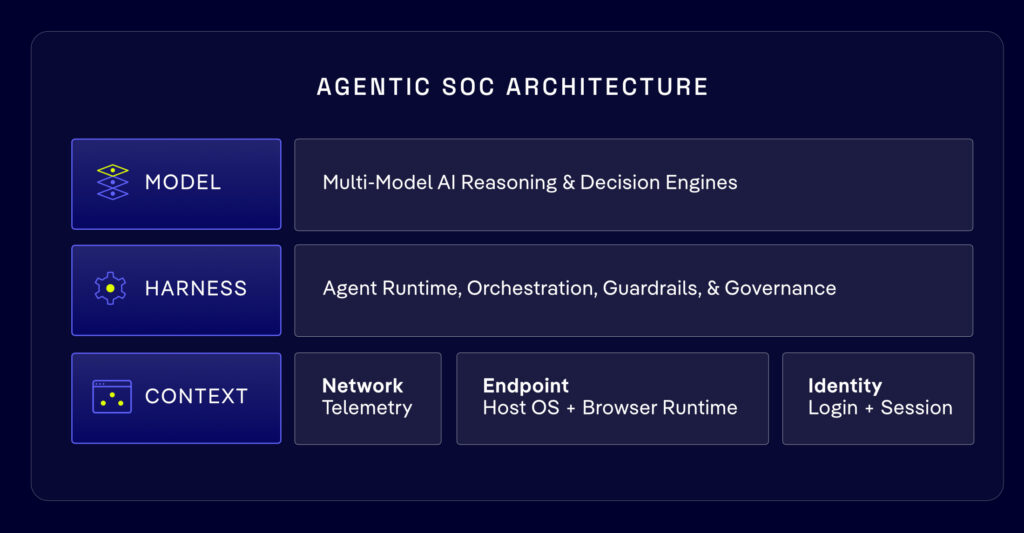
- Extending Endpoint Context (Host OS + Browser Runtime): Traditional EDR sees process execution, system calls, and binary behavior on the underlying operating system. However, the modern user spends their day inside the browser runtime. Extending Endpoint context into the browser session allows autonomous agents to observe DOM-level actions, extension behaviors, third-party script executions, and client-side code scraping that host-level EDR sits beneath.
- Extending Identity Context (Authentication + In-Session Behavior): Traditional IAM telemetry validates access at the front door—tracking authentication events, SAML assertions, and MFA challenges. Extending Identity context into the active session gives AI agents post-authentication visibility, verifying how authenticated tokens and active user sessions are actually behaving once inside an application.
The Value of Complete Evidence
The Agentic SOC Alliance emphasizes that providing agents with structured, discoverable context leads to “fewer tokens, faster answers, and lower reasoning complexity.”
When an AI agent investigates an incident with full access to both host-level and session-level telemetry, it avoids the trap of false assumptions. If a third-party script quietly harvests data out of a form or an attacker uses AI tools to probe proprietary frontend code, host-level EDR sees a standard browser process, NDR sees encrypted HTTPS traffic to a trusted endpoint, and IAM shows a valid login.
By feeding the browser session signal into the shared Context layer, the autonomous agent receives complete ground-truth evidence, allowing it to accurately confirm or dismiss threats without spending cycles reconstructing missing telemetry.
Closing the Gap: Bringing the Browser into the Context Layer
To fulfill the promise of machine-speed defense, browser telemetry and execution controls must be integrated directly into the Agentic SOC operating model as a first-class Context provider.
Closing this gap requires three capabilities:
- Client-Side & Browser Telemetry: Ingesting real-time visibility into DOM events, third-party script execution, browser extension activity, and client-side data flows alongside traditional host and network signals.
- Real-Time Enforcement: Enforcing least-privilege controls inside the browser runtime, restricting third-party scripts to only the DOM elements and data they strictly require, while blocking malicious script harvesting, AI-driven code probing, unauthorized data pastes, and session theft at the exact moment and location they occur.
- Discoverable Signal for AI Agents: Structuring browser activity into a semantically rich operational graph. Browser telemetry must be presented as actionable context that autonomous agents can query without burning tokens on raw log parsing.
Building a Unified Architecture for Machine-Speed Defense
Bringing enterprise browser telemetry into the Agentic SOC ecosystem strengthens the overall defense model by making every layer of the architecture more effective.
In a unified joint architecture, telemetry sources work in concert across the shared Context layer:
- NDR surfaces network transport anomalies, protocol patterns, and lateral movement.
- EDR monitors host health, underlying OS binaries, and system processes.
- IAM tracks identity boundaries, authentication requests, and access rights.
- Enterprise Browser Telemetry captures rendered session activity, DOM actions, third-party script execution, and in-browser data movement.
When the Harness layer orchestrates an autonomous agent to investigate an alert, the agent queries a unified operational graph. It can trace an incident seamlessly from an initial third-party script-harvesting event in the browser session to a session token anomaly to an endpoint process change to a network communication attempt, enabling precise, automated containment at machine speed.
Conclusion: Driving Accuracy Through Complete Context
The transition toward an Agentic SOC represents a vital advancement for enterprise cybersecurity. Building operations around autonomous AI agents gives defenders the leverage needed to match the speed of modern AI-driven attacks.
Because an AI agent’s reasoning is bounded by the evidence it can access, ensuring the Context layer captures the full scope of enterprise activity is critical. Incorporating browser and session telemetry into the existing Endpoint and Identity pillars provides autonomous agents with the deep visibility required to protect modern workflows, proprietary code, and client-side data.