






The latest Code Integrity release builds on Jscrambler’s LLM-resilient foundation with code-hardening improvements that broaden protection coverage, ensuring stronger defense against AI-driven reverse engineering.
As AI threats become more prominent, the Jscrambler team analyzed how various AI tools operate and enhanced the obfuscation layer to deliver more robust protection against LLM-based threats.
Your Code is One AI Prompt Away from Being Reverse-Engineered
For years, source code obfuscation relied on a simple assumption: if code was difficult enough for a human to understand, most attackers would give up before uncovering its logic. Complexity itself acted as a deterrent. That assumption no longer holds.
Modern large language models (LLMs) have fundamentally changed the economics of reverse engineering. Tasks that once demanded specialized expertise can now be initiated with a prompt, dramatically lowering the barrier to understanding protected code. What previously required anywhere from several hours to days of manual analysis can now be completed in just a few hours or even minutes, at scale.
This shift extends beyond faster code analysis. The latest generation of agentic AI systems doesn’t just explain code; it can plan, execute, iterate, and adapt. These models use developer tools, run code in sandboxed environments, test different approaches, and refine their strategy when they encounter obstacles. Instead of acting as passive assistants, they increasingly behave like autonomous reverse engineers.
Defending against this new class of attacks requires a different approach: one that hardens code specifically to disrupt machine reasoning.
Current LLMs Limitations
While agentic AI significantly lowers the barrier to attempting code analysis, modern models are far from infallible. Their ability to reverse-engineer applications is constrained by fundamental structural limitations:
- Inference Dependence: AI agents do not perform line-by-line logic reconstruction; instead, they attempt to infer overall intent from contextual code cues. When these semantic anchors are removed, the model’s reasoning degrades into speculative guessing.
- Success Hallucination: Models routinely overestimate task completion. In testing, agents frequently reported successful deobfuscation on code that remained heavily protected or contained silent logical errors.
- Runtime Fragility: Sometimes agents need to execute code dynamically to verify their analysis. This transition creates a critical bottleneck, as active runtime defenses can disrupt the execution environment and cause the automated process to stall or fail.
- Economic & Human Audit Overhead: Token consumption and analysis time scale non-linearly on enterprise codebases. Because models produce unreliable outputs, expert human intervention is still required to audit every result, reintroducing the exact operational friction automation was meant to eliminate.
The Jscrambler Solution: AI Resilience by Default
At Jscrambler, our core philosophy is that AI resilience must be built in by default, not bolted on. That means embedding protections directly into our standard templates and custom configurations, so clients can create an AI-Resilient codebase without needing specialized security expertise. This matters more than ever as AI lowers the barrier to entry for reverse engineering, allowing attackers to probe and exploit code without advanced technical skill.
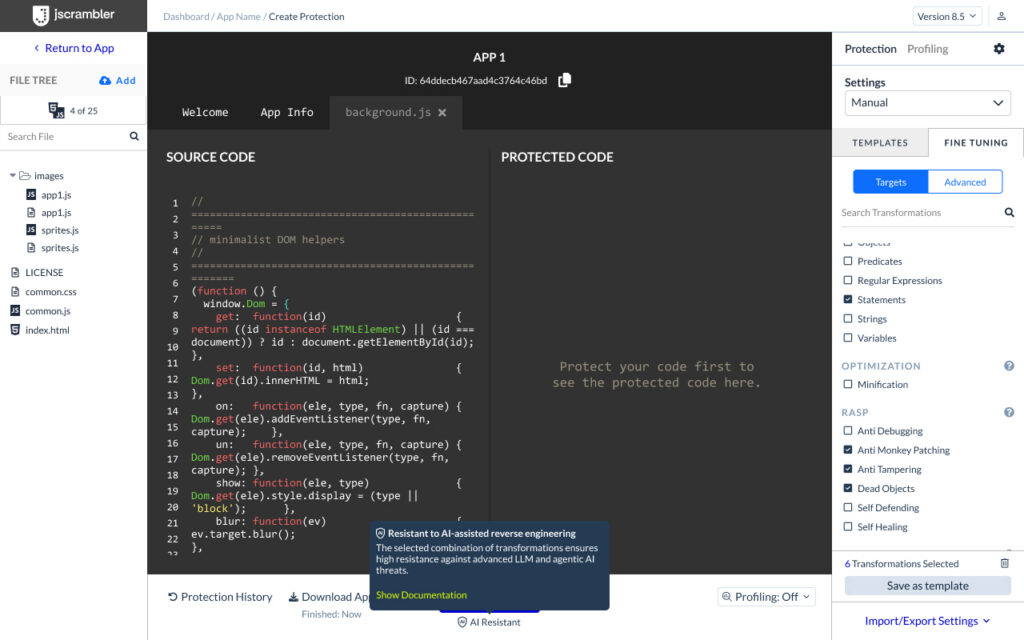
In the Code Integrity dashboard, as you configure your protection recipe, you’ll see an indicator when your settings reach AI-Resilient status.
With Jscrambler Code Integrity 8.6, we have advanced our core layer that counters reverse engineering by introducing new techniques specifically designed to disrupt AI workflows. These upgrades target AI inference limitations, leading models to make false assumptions and prematurely claim successful deobfuscation even when the core logic remains untouched.
As a powerful complementary measure, active Runtime Protections further strengthen this posture. When agents execute code dynamically to test hypotheses, dynamic barriers engage to interrupt automated analysis. Together, these complementary layers raise the cost of both static and dynamic analysis, making automated attacks impractical at scale.
Key Benefits of the New Anti-AI Strategies
To counter AI-driven threats, we benchmarked state-of-the-art models against three real-world deobfuscation strategies, mapping both their capabilities and limitations. Rather than reinventing the Jscrambler stack, the team used the insights to harden our existing core layers, specifically targeting the operational blind spots of AI coding agents. This delivers seamless, upgraded security across our clients’ current profiles.
The key benefits of the latest LLM-resilience layer can be summarized as follows:
- Research-backed defense against AI-driven reverse engineering
The Jscrambler team benchmarked leading AI models against real-world deobfuscation strategies, then engineered countermeasures based on their actual capabilities and limitations, so protection is grounded in how LLMs actually attack code. - Broader protection coverage, no reconfiguration needed
Rather than rebuilding the stack, Jscrambler hardened its existing polymorphic obfuscation layers to close the specific blind spots AI coding agents exploit. Our core protections and standard templates have been directly enhanced with LLM-resilient techniques. You get stronger security across your existing protections, with no additional settings to reconfigure. - Built to stay ahead of evolving AI capabilities
The upgrade reflects an ongoing research cycle (not a one-time patch), positioning Jscrambler to keep pace as LLMs and agentic tools grow more capable at reverse engineering.
Future-Proofing AI Resilience
Looking ahead, our goal is simple: skew the economics of attack and continue to exploit inherent LLM limitations. While our current release already establishes a strong computational barrier, our ongoing roadmap continuously increases the time and resources required to breach defenses and reduces the likelihood that an LLM can reason about code logic, keeping client applications permanently ahead of evolving AI threats.
Check out our webinar to explore LLM-resilient code.