
Table of contents
Security leaders today face a familiar mandate: consolidate tools, reduce operational complexity, and improve efficiency. Web Application Protection Platforms (WAPPs) have emerged as a compelling answer, promising unified protection across WAF, API security, and bot management. As client-side attacks surge and compliance requirements evolve, an important question remains:
Can platform-based approaches deliver the depth of protection modern web applications require? This question is at the heart of Forrester’s latest research, The Rise of Web Application Protection Platforms, and it’s exactly what will be explored in Jscrambler’s upcoming webinar featuring Forrester, BT Group, and Marriott Vacations Worldwide.
A Missing Layer in Modern Web Security
Web applications rely heavily on dynamic client-side code and scripts to meet their business and marketing goals, supporting analytics, payment services, marketing integrations, and more.
These software supply chain-delivered scripts come from third parties, often unchecked, thereby expanding the web's attack surface and exposing organizations to skimming attacks and data compromise.
Client-side attacks - such as Magecart skimming, malicious third-party scripts, and web supply chain compromises - execute directly in the browser, beyond the visibility of traditional security controls. These attacks can:
Steal payment and personal data in real time;
Bypass WAFs and server-side monitoring entirely;
Persist undetected while impacting millions of users;
Create significant financial, operational, and reputational risk.
In addition, the browser has become the point of value creation. The place where data currency is born. Whether it's sensitive data being entered into form fields, resulting in regulatory fines, or competitive information being leaked to third-party vendors in support of their services, the browser is now the center of gravity that must be prioritized.
As data risk expands beyond the traditional edge, client-side protection is no longer optional; it is essential.
Consolidation vs. Depth
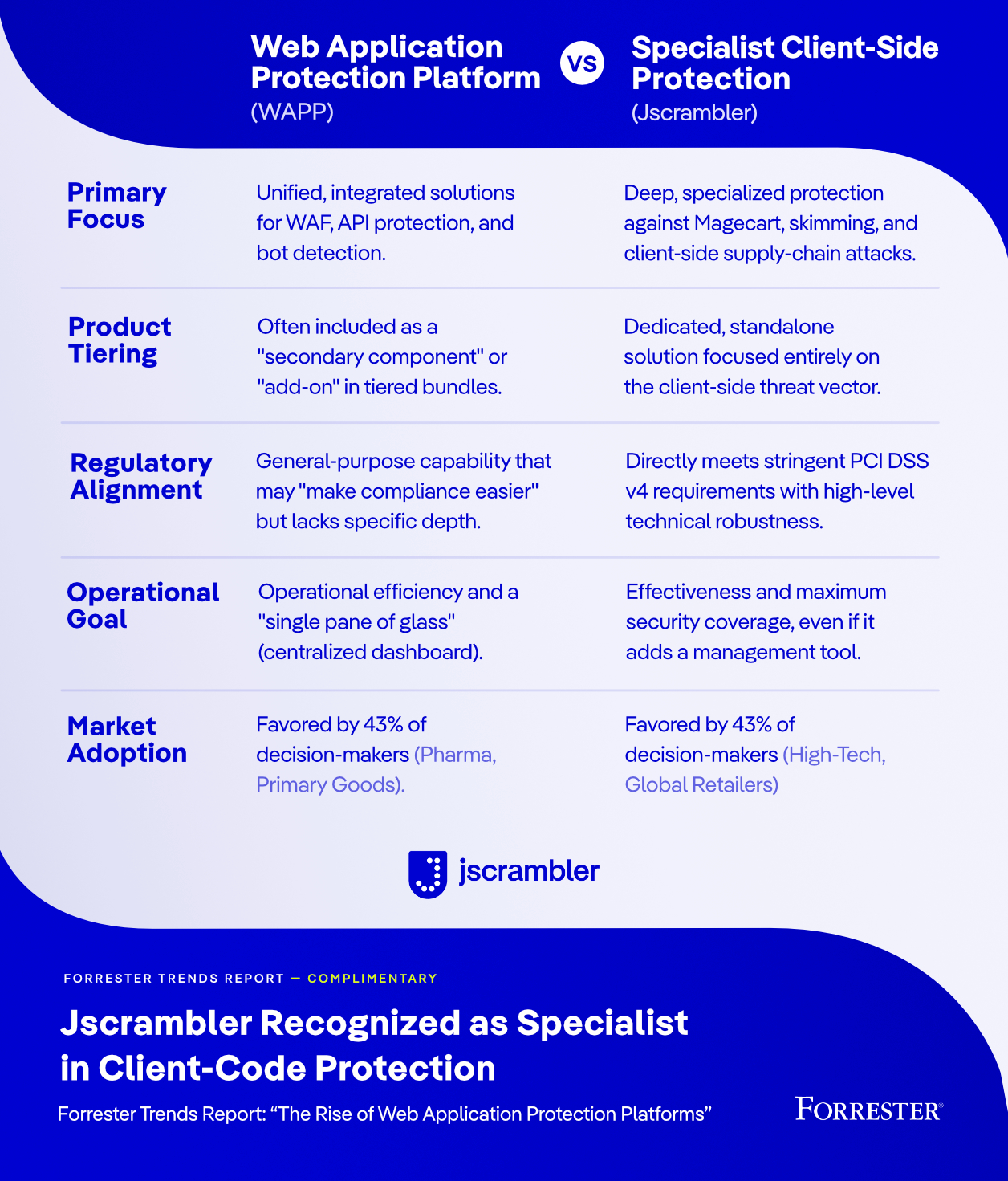
There’s an important reality: while WAPPs deliver operational efficiency through consolidation, their client-side protection often lacks the depth needed to address today’s most sophisticated browser-based threats.
WAPPs excel at:
Providing centralized visibility and management
Protecting server-side infrastructure and APIs
Streamlining operations through platform consolidation
However, client-side protection is often delivered as an add-on capability rather than as a purpose-built security layer.
Additionally, WAPPs introduce notable concentration risks and potential vendor lock-in. Relying on a single provider for multiple security functions creates a "rip and replace" scenario if the relationship sours, the vendor’s roadmap fails to keep pace with the market, or the service quality declines.
Specialized client-side protection solutions, on the other hand, are designed specifically to:
Continuously monitor client-side JavaScript execution
Detect malicious or unauthorized script behavior
Prevent digital skimming and Magecart-style attacks
Protect against web supply chain compromises
Provide the technical depth required to meet modern compliance standards
The takeaway is clear: efficiency matters, but effectiveness matters more.
PCI DSS v4 Has Raised the Stakes
Compliance requirements are accelerating the urgency around client-side protection. PCI DSS v4 introduces explicit requirements for:
Inventorying and monitoring client-side scripts
Detecting unauthorized modifications
Maintaining visibility into the integrity of browser-executed code
Defending against e-skimmers and other client-side threats
Meeting these requirements demands purpose-built client-side security capabilities rather than extensions of server-side protections that are often added as an afterthought. Organizations that rely solely on traditional platform controls may find themselves exposed not only to threats but also to compliance and data risks at higher overall cost.
Why Leading Enterprises Are Adopting Specialized Client-Side Protection
Security leaders are increasingly recognizing that client-side threats require dedicated protection.
The organizations leading this shift are prioritizing:
Proactive Risk Reduction: Neutralizing threats at the source to prevent data exfiltration before a breach can occur.
Continuous Compliance: Streamlining PCI DSS v4 adherence with automated controls and "audit-ready" reporting.
Granular Visibility: Eliminating blind spots by monitoring every script, extension, and third-party asset executing in the user's browser.
Defense-in-Depth: Hardening the attack surface against sophisticated, modern techniques that bypass traditional perimeter defenses.
Specialized Subject Matter Expertise: Leveraging dedicated experts who provide deep, responsive support and specialized knowledge to handle rapidly evolving threats
Rather than replacing WAPPs, specialized client-side protection complements them—closing critical security gaps and strengthening overall defense.
Join Forrester, BT Group, and Marriott Vacations Worldwide for an Exclusive Webinar
To help security leaders navigate this evolving landscape, Jscrambler is hosting a webinar featuring Forrester analysts and enterprise security practitioners who are actively addressing these challenges. This is a unique opportunity to gain independent research insights alongside real-world enterprise experience.
Security platforms have transformed how organizations manage and deploy protection, but protecting users and businesses requires visibility and control where attacks actually occur: in the browser.
.jpg)
This webinar will help you understand the risks, evaluate your strategy, and make informed decisions based on independent research and enterprise best practices.


